
How to plan a brand launch in Brussels: the 2026 playbook
A brand launch is not a corporate event. It's a performance.
For the hours or days it occupies, it concentrates commercial stakes, media strategy, brand credibility, and the long-term memory of guests. Every detail matters. The venue that hosts it particularly so.
This guide breaks down how to plan a successful brand launch in Brussels in 2026: the four structural pillars, the realistic timeline, the pitfalls to avoid, and the exact role of the venue in the equation.
Why brand launches are the most demanding format
A networking cocktail can be simple. A gala dinner is well framed. A corporate conference follows a known pattern.
A brand launch stacks all the challenges at once:
- Differentiation: the brand must stand out from an ocean of existing content
- Amplification: every touchpoint must be shareable, photographable, storytell-able
- Multi-audience: dealers, press, influencers and customers have very different expectations
- Timing: the communication window around the product launch is short
- Memorability: guests must leave the venue knowing the product "from the inside"
A failed brand launch means hundreds of thousands in marketing budget going up in smoke. A successful one means measurable ROI over 12 months of commercial pipeline.
The 4 pillars of a successful brand launch
1. The venue that becomes a stage
A premium brand launch does not "rent a venue". It occupies, transforms, and makes it disappear so only the brand remains.
This requires:
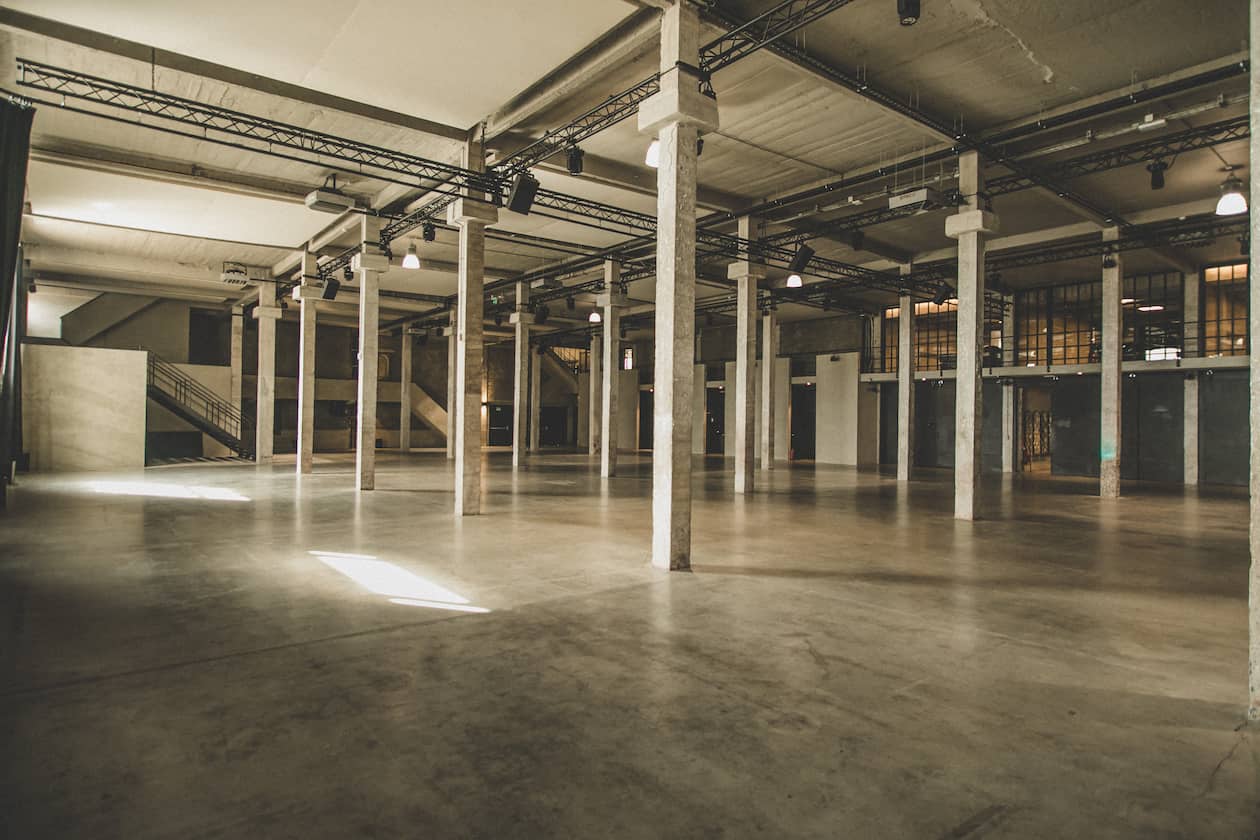
- A modular venue that accepts heavy transformations (rigging, scenography, custom lighting)
- Enough surface to compartmentalise by audience (VIP room, press, showroom)
- An architectural identity that is neutral or complementary to the brand, never competing
- A weather Plan B if outdoor zones are used
Brussels has a handful of venues that check these boxes. The Meudon Hall at SILO Brussels (1,341 m² of 1930s industrial heritage) is one of the most flexible for this format.
2. The scenography that extends the brand
Scenography is not decoration. It's the brand's physical language applied to a 3D space.
A successful brand launch scenography:
- Translates brand values into material and sensory elements
- Guides the eye toward the product without over-signalling it
- Creates photogenic zones for press and guests
- Remains effective after teardown: captured visuals live for months on networks
Brussels and Flemish agencies specialising in brand scenography include studios like WE MAKE YOU HAPPY, which recently orchestrated the Japanese-inspired scenography of the Mazda CX-6e launch at SILO.
3. The guest flow that smooths the experience
Guest flow is the invisible infrastructure of a successful brand launch.
It covers:
- Pre-arrival (parking, welcome, cloakroom, badge)
- Journey (frictionless guided path, programmed moments)
- Pauses (breathing spaces, catering, restrooms)
- Exit (final impression, gifting, transport)
Actors like Fluxology specialise precisely in this orchestration.
4. The programme that paces the day
A 4-hour brand launch and a 4-day brand launch are not designed the same way.
The programme must:
- Create several photogenic and story-worthy key moments
- Segment audiences (the dealer pitch is not the journalist pitch)
- Provide micro-formats (test drives, workshops, Q&A sessions)
- Culminate in a reveal or an unforgettable central moment
A recent brand launch at SILO, the Mazda CX-6e reveal produced by WE MAKE YOU HAPPY, gathered 1,000 guests over 4 days with distinct programmes per audience. This level of segmentation separates memorable launches from standard ones.
The realistic timeline: from D-180 to D+7
D-180 to D-120 (6 months out)
Strategic brief framing. Venue shortlisting and internal validation. Venue contract signed, deposit paid. Production agency framing.
D-120 to D-90 (4 to 3 months out)
Scenographic concept validated. Programme per audience defined. AV, catering, mobility suppliers briefed. Save-the-date sent.
D-90 to D-60 (3 to 2 months out)
Scenography production launched. Video and photo content pre-produced. Official invitations sent. Guest list finalised per audience.
D-60 to D-30 (2 months to 1 month out)
Technical rehearsals. On-site team briefing. Signage validated. Weather Plan B confirmed if applicable.
D-30 to D-7 (final stretch)
Guest confirmation per audience. Full rehearsal on site. Security and protocol briefing. Watch communication.
D+1 to D+7 (post-event)
Warm team debrief. Photo and video content publication. Press follow-up and media relations. Initial ROI report.
The 5 mistakes that cost a brand launch
Mistake 1: Underestimating AV production
A multi-camera livestream with simultaneous translation is briefed 3 months out. Waiting until D-30 to request quotes means doubling the invoice or accepting visible technical compromises.
Mistake 2: Choosing a venue too large or too small
A venue too large drains the energy. Too small creates logistical stress. The rule: 3 to 4 m² per guest for cocktail, 1.5 to 2 m² for seated-conference.
Mistake 3: Ignoring guest flow
A beautiful setup with a 30-minute queue at the entrance compromises the image. Guest flow is not optional, it's a pillar.
Mistake 4: Not segmenting audiences
Pressing dealers, journalists and customers into the same experience dilutes the message. Each audience deserves its own programme, even if short.
Mistake 5: Neglecting the post-event
The launch does not end when guests leave. Post-event content often generates more network impact than the event itself.
How SILO Brussels supports a brand launch
At SILO Brussels, brand launch support includes:
- A dedicated in-house project manager from briefing to debrief
- 9 modular spaces usable separately or in combination
- Artfood catering coordination with menus customisable per audience
- AV and rigging support for heavy scenographies
- Network of pre-vetted partners (production, mobility, communication)
- Integrated Plan B between indoor and outdoor
For a 500 to 1,500-guest brand launch, expect an initial conversation within 48 hours and a full quote within 5 days.
Frequently asked questions
How much does a premium brand launch cost in Brussels?
Depending on scale, between 80,000 and 500,000 euros all-in for a 300 to 1,500-guest event. Scenography typically accounts for 30 to 45% of the budget.
How far in advance should we book?
Six months minimum for a 500-plus-guest launch on a premium date. Three months for a lighter format.
Can multiple SILO spaces be combined for a brand launch?
Yes. Meudon Hall for the central reveal, Atelier & Mezzanine for the VIP zone, Kiosque for a more intimate press briefing: the combination is frequent.
Does SILO Brussels allow scenographies with suspended structures?
Yes. The 1930s brewery frame is engineered to accept heavy rigging. Each project is validated with the technical team.
How does SILO manage confidentiality for a product launch?
Standard NDA signed with suppliers, personalised access control, media embargo possible. The topic is addressed from the first conversation.
Plan your 2026 brand launch
If you are preparing a brand launch in Brussels for the next 12 months, the optimal window to secure the venue closes quickly, particularly for October to December dates.
Send your brief to SILO Brussels: silobrussels.be/en/contact. Reply within 48 hours.