
Sustainable events in Brussels: the SILO approach
Five years ago, sustainability sat on the last line of the event brief, somewhere between the cloakroom and the parking. In 2026, it sits on page one of RFPs. Corporate buyers ask for proof, not intentions: caterer sourcing, waste management, accessibility, mobility footprint.
This shift is not a constraint. Anticipated well, it simplifies choices, cuts certain costs and strengthens the event's image. Here is how SILO Brussels approaches sustainability, pillar by pillar, and what it concretely changes for your event.
Why sustainability became a venue selection criterion
Three dynamics have aligned in recent years:
- Corporate CSR policies: procurement teams integrate measurable environmental criteria into every event RFP
- Guest expectations: a visibly wasteful event damages the image of the brand hosting it
- Brussels regulation: mandatory waste sorting, low-emission zones, soft mobility incentives
Direct consequence: venue choice is no longer just about capacity and aesthetics. A poorly located, energy-hungry venue with no waste policy loses points from the evaluation grid onwards.
Pillar 1: mobility
The biggest carbon line of a corporate event is neither catering nor lighting. It is guest travel.
SILO sits on the canal, 10 minutes from Brussels-Midi station, the country's main rail hub. In practice:
- Public transport: direct access by metro, tram and bus
- Bike: bike shelters in local wood installed on site, in the spirit of the building's conversion
- Group shuttles: organisable from a central point with our mobility partner Fluxology
- Car: nearby parking for guests without an alternative, with flow management to avoid idling engines
An event that clearly communicates its soft mobility options in the invitation measurably reduces the share of individual cars.
Pillar 2: the building
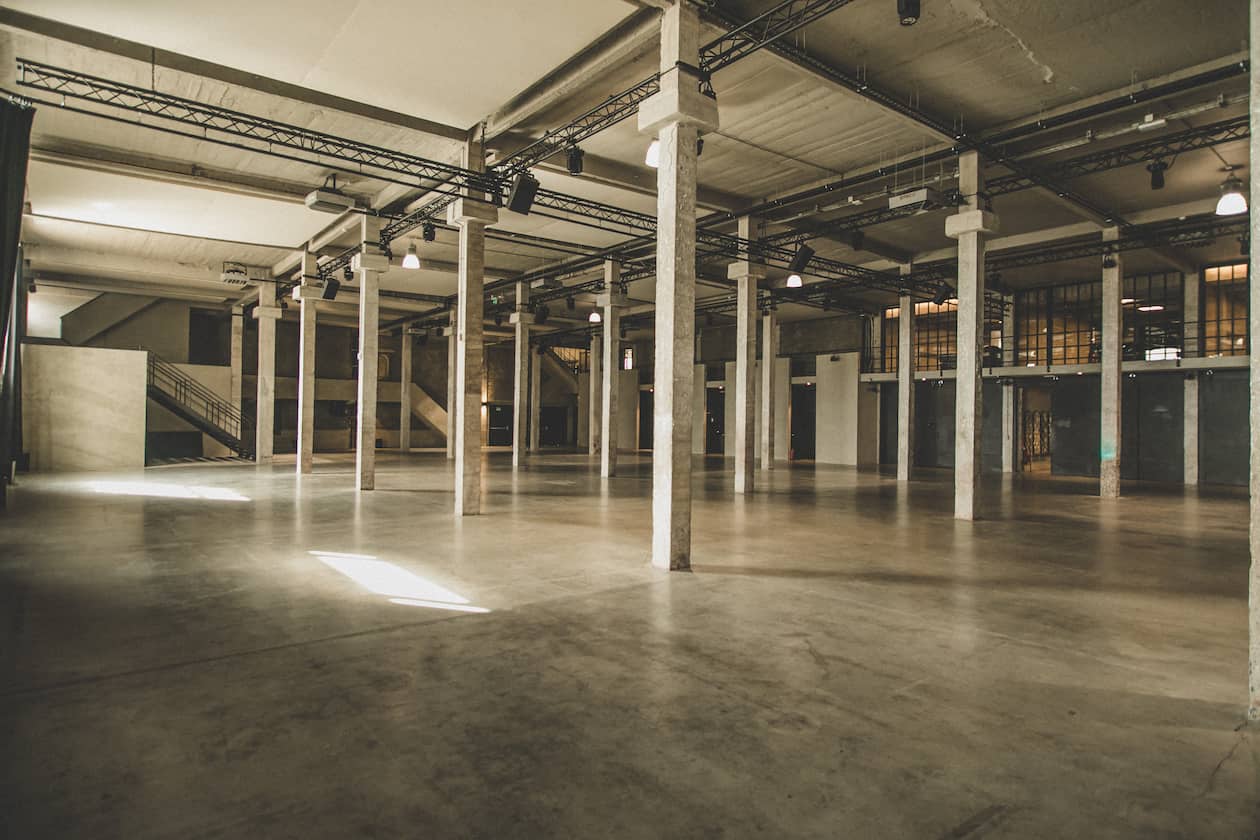
SILO is a converted 1930s brewery. The conversion itself is the most important sustainable gesture: reusing 10,000 m² of industrial heritage rather than building new.
Day to day:
- No fossil-fuel heating required for summer events: the building's thermal mass naturally regulates temperature
- Abundant natural light in most spaces, reducing artificial lighting during the day
- Modular spaces: adjusting the surface used to the real guest count avoids heating or cooling useless square metres
Pillar 3: catering
Catering is the most visible line for your guests. Artfood, our in-house catering partner, works on three axes:
- Local and seasonal sourcing to cut food miles
- Quantity calibration thanks to guest count confirmation at D-14, limiting surplus
- Vegetarian options as standard, not as a supplement
For organisers who want to go further, fully vegetarian menus or anti-waste formats are built during the briefing.
Pillar 4: waste
An in-house team manages sorting at every event: PMC, glass, paper-cardboard, organic and residual waste. Sorting is integrated into the teardown flow, not added afterwards.
For events with booths or scenography, the waste conversation starts at the briefing: reusable materials, undated signage for reuse, rented rather than purchased furniture. We gathered our best practices in a dedicated guide.
Pillar 5: accessibility and inclusion
A sustainable event is an event accessible to everyone. SILO is Access-i certified: the site's accessibility was assessed by an accredited agency, and the information is public and transparent for your guests with reduced mobility. The rooftop itself is reachable by elevator.
We also collaborate with Cap Event asbl, a pioneer of inclusion in the Belgian event sector, for events that celebrate diversity in all its forms.
Pillar 6: hybrid as a carbon lever
The most underestimated lever: avoiding travel rather than offsetting it. With fibre internet and a full AV pack available on site, a SILO event can connect remote participants without sacrificing production quality. For an international conference, letting part of the audience follow remotely cuts the total footprint far more than any waste sorting.
The sustainability checklist for your next brief
To integrate sustainability from the brief, mention:
- Your guest mobility policy (shuttles, public transport incentives)
- Your caterer sourcing requirements
- Your expectations on sorting and waste reporting
- Your guests' accessibility needs
- The share of the audience that could attend remotely
A serious venue must be able to answer these five points in writing. At SILO, these answers are part of the standard quote.
Frequently asked questions
Can SILO provide post-event sustainability reporting?
Yes. On request at the briefing, we document sorted waste volumes and mobility options used, to feed your CSR reporting.
Do sustainable menus cost more?
No. Local and seasonal sourcing is the Artfood standard, at no supplement. Anti-waste formats can even reduce the catering line.
Is the site accessible to people with reduced mobility?
Yes, SILO is Access-i certified and all main spaces, rooftop included, are reachable by elevator.
Can an event be organised without single-use plastic?
Yes. Reusable cups, plastic-free signage and alternatives to laminated badges are planned from the briefing.
Plan an event that ticks page one
If your 2026 RFPs put sustainability on page one, venue choice is your fastest lever. A well-connected site, a local caterer, integrated sorting and an accessibility certification earn points before the first quote.
Let's talk about your event: silobrussels.be/en/contact. Reply within 48 hours.